Yoga for Athletic Recovery: Postures to Increase Flexibility and Calm the Body
Discover how restorative yoga protocols activate the parasympathetic nervous system, downregulate cortisol, and accelerate muscular recovery for athletes.
Expert reviewed by Shivam Gupta, CSCS, CPT on Reviewed for accuracy by the professional named here. How we label reviews
In This Article
Many serious lifters and endurance athletes view yoga as either a gentle meditation circle or an acrobatic contortion act. Both stereotypes miss the profound athletic value of restorative, recovery-oriented yoga.
When you lift heavy weights or complete grueling sprint intervals, you drive your autonomic nervous system into intense sympathetic (“fight or flight”) dominance. While this state is necessary to produce power, true muscular repair and glycogen replenishment only occur when you transition into the parasympathetic (“rest and digest”) branch.
Restorative yoga is the biological bridge that accelerates this critical transition.
The Physiology of Passive Stretching and Downregulation
Unlike active resistance training, recovery yoga utilizes long, passive holds supported by gravity and deliberate diaphragmatic breathing:
- Golgi Tendon Organ (GTO) Activation: When a muscle is held under gentle passive tension for more than 30 to 45 seconds, sensory GTO receptors override the protective myotatic stretch reflex, allowing muscle fibers to lengthen safely.
- Vagal Stimulation: Slow, rhythmic exhalations (at least 6 seconds long) stimulate the vagus nerve, immediately lowering heart rate and blunting elevated cortisol.
Five Essential Recovery Postures for Trainees
1. Extended Child’s Pose (Balasana)
- Target: Decompresses the lumbar spine, lengthens tight lats, and opens the hips.
- Execution: Kneel on your mat, bringing your big toes together and spreading your knees wide. Sink your hips back onto your heels while walking your hands out in front of your head. Rest your forehead on the floor and breathe into your lower ribs for 2 to 3 minutes.
2. Reclined Pigeon / Figure-4 (Supta Kapotasana)
- Target: Releases the piriformis and external hip rotators without loading the knee joint.
- Execution: Lie on your back with knees bent. Cross your right ankle over your left knee. Reach through and grasp your left hamstring, gently pulling your knee toward your chest. Keep your right foot flexed to protect your knee. Hold for 90 seconds per side.
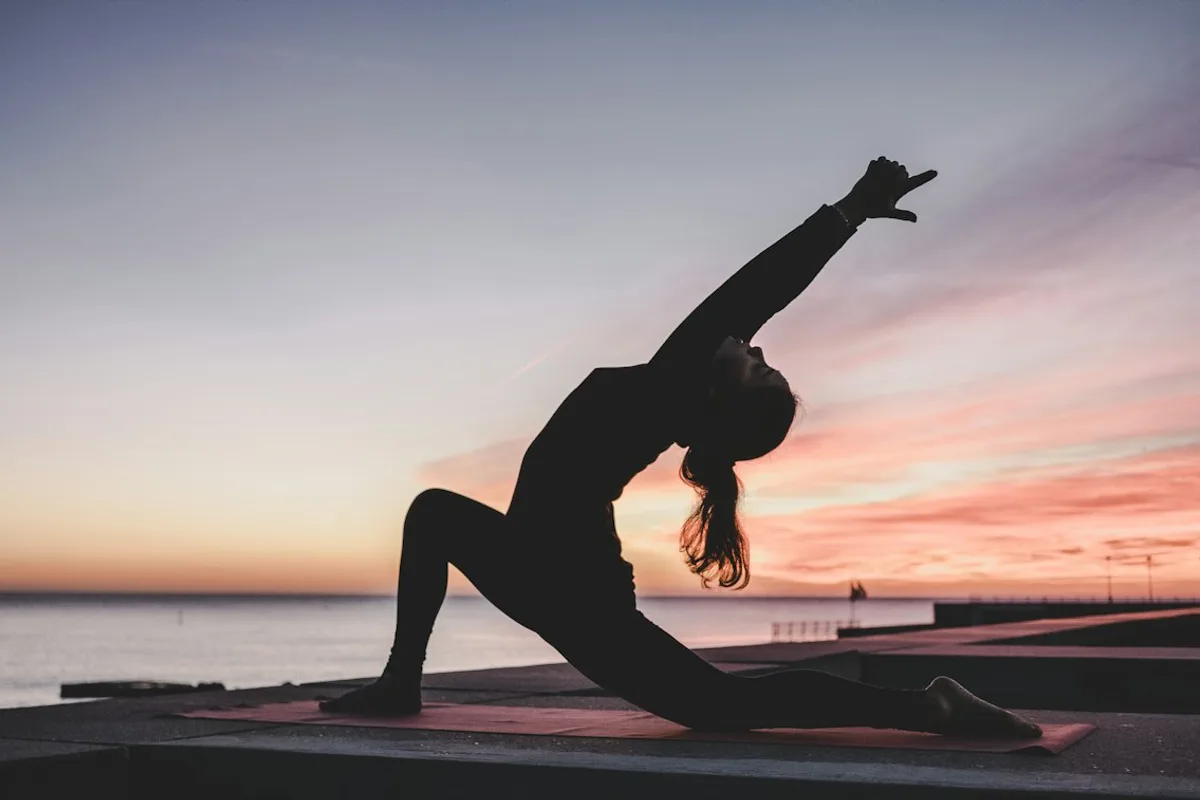
3. Low Lunge with Side Bend (Anjaneyasana)
- Target: Stretches the psoas, iliacus, and quadratus lumborum.
- Execution: Step into a low lunge with your back knee down. Reach your arm on the trailing side straight overhead, then gently lean your torso toward the opposite side. This lengthens the entire lateral fascial chain.
4. Legs-Up-The-Wall (Viparita Karani)
- Target: Promotes venous return, lymphatic drainage in the legs, and nervous system calm.
- Execution: Sit sideways against a wall, then swing your legs up the wall as you lie back onto the floor. Let your arms rest comfortably by your sides with palms turned upward. Close your eyes and remain here for 5 to 10 minutes.
| Posture | Primary Tissue Lengthened | Optimal Duration | Breathing Focus |
|---|---|---|---|
| Extended Child's Pose | Latissimus dorsi, lumbar erectors, hips | 2 to 3 minutes | 360-degree belly expansion into thighs |
| Reclined Figure-4 | Piriformis, deep gluteal stabilizers | 90 sec per side | Relax jaw and shoulders on long exhales |
| Low Lunge Side Bend | Psoas, rectus femoris, QL | 60 sec per side | Expand ribs upward away from hip crest |
| Legs-Up-The-Wall | Hamstrings, calves, venous circulation | 5 to 10 minutes | Slow 4-second inhale, 6-second exhale |
The Bottom Line
Recovery is not passive couch sitting; it is an active discipline. Integrating 15 to 20 minutes of restorative yoga into your weekly training schedule will pay immediate dividends in reduced muscle soreness, enhanced joint mobility, and restorative sleep.
Sources
HealthScope uses government health agencies, medical institutions, and peer-reviewed research to support the facts in our articles. Read our sources policy.
- European Journal of Preventive Cardiology. The Effects of Yoga on Cardiovascular Disease and Metabolic Syndrome (opens in a new tab). 2014.
- Frontiers in Human Neuroscience. Yoga and Parasympathetic Nervous System Regulation (opens in a new tab). 2014.